How a lab website strengthens your grant application

How a Well-Maintained Website Strengthens Your Grant Applications

Every lab website grant application review starts the same way, a funding agency opens your proposal, then opens your website. What they find there shapes everything that follows. A current, well-maintained lab website strengthens your grant application by confirming your lab's credibility, productivity, and capacity to deliver on the work you are proposing, before a single line of your proposal is read

Why Your Lab Website Grant Application Review Starts Online

Grant reviewers are busy people with limited time and a stack of applications to evaluate. When something in your proposal catches their attention, a collaborator's name, a methodology, or a preliminary finding, they will often check your website to verify it. What they find there either supports your narrative or undermines it.

A well-maintained research lab website confirms that your lab is active, productive, and organized. It shows that your publications are current, your team is in place, and your research direction is coherent. Furthermore, it provides context that a grant proposal simply cannot. A reviewer who visits your site and finds a publication list that matches your citations, a team page that reflects who you say is working on the project, and a research focus that aligns with your proposal will feel confident moving forward. A reviewer who finds a website frozen in 2021 may not.

How Your Lab Website Builds Grant Application Credibility

Credibility in grant applications isn't built through proposals alone. It is built over time, through publications, presentations, and the consistent public presence of your lab. A research lab website is one of the most visible and persistent expressions of that presence.

When your website accurately reflects your lab's current work, it does several things that directly strengthen your grant application. First, it validates your track record. A publications page that is regularly updated demonstrates consistent output, which is exactly what funding agencies want to see. Second, it confirms your team's expertise. A well-maintained team page with current bios and credentials reinforces the qualifications you list in your personnel section. Third, it signals organizational capacity. A lab that cannot keep its own website current raises an implicit question about whether it can manage a complex, funded project.

The transition from a disorganized or outdated website to a current and professional one is therefore not just a cosmetic improvement. It is a credibility investment that pays dividends across every application you submit.

Your Lab Website Is Part of Your Grant Application Strategy

Most grant writers focus exclusively on the written proposal: the specific aims, the methodology, the budget justification. These are obviously critical. However, the written proposal does not exist in isolation. Reviewers bring context to everything they read, and your lab's online presence is a significant part of that context.

A strong online presence for your research lab means that when a reviewer searches for your name or your lab, they find evidence that supports your proposal rather than contradicting it. It means your preliminary data is described on your website. It means your recent publications are visible and accessible. It means your collaborators can be verified. Consequently, maintaining your research lab website is not just a communication task, it is a grant strategy.

Labs that understand this treat their website the same way they treat their CV. They keep it current because they know it will be reviewed, and they know that what reviewers find will influence how they perceive everything else.

How a Well-Maintained Lab Website Supports Grant Reviewers

Understanding what grant reviewers are actually looking for makes it easier to see exactly how a research lab website helps. Reviewers are typically assessing significance, innovation, approach, investigator qualifications, and environment. A well-maintained website can directly support at least three of these criteria.

For investigator qualifications, your website should show a consistent publication record, active research projects, and a capable team. For the environment, your website communicates the infrastructure and collaborative culture of your lab, both of which reviewers weigh when evaluating whether your lab can realistically execute the proposed work. For significance and innovation, a research page that clearly articulates your lab's focus and how your current work fits into the broader landscape of your field helps reviewers quickly understand why your proposal matters.

Beyond those criteria, a well-maintained research lab website also makes it easier for program officers — who often champion applications internally — to advocate for your work. When a program officer can point to a professional, current, well-organized site as evidence of your lab's capacity, it strengthens the case they make on your behalf.

What an Outdated Lab Website Costs Your Grant Application

The cost of an outdated research lab website is largely invisible, which is precisely what makes it dangerous. You will rarely receive feedback from a reviewer saying your website hurt your application. Nevertheless, the impact is real.

An outdated publication list suggests your productivity has declined. A team page that still lists members who left two years ago raises questions about lab stability. A research focus page that describes work your lab has since moved on from creates confusion about what you are actually proposing. Each of these gaps introduces doubt, and doubt is the enemy of a strong grant application.

Moreover, the cost compounds over time. With each funding cycle you go through with an outdated website is another cycle where reviewers are forming impressions based on incomplete or inaccurate information. Conversely, every update you make: every new publication added, every team member profile refreshed, incrementally strengthens the case your website makes on your behalf.

Building a Lab Website That Works for Every Grant Application

Maintaining a research lab website with grant applications in mind does not require a major overhaul. It requires consistency and a clear sense of what reviewers are looking for. A few practical priorities make a significant difference.

Publications should be updated as soon as papers are accepted or published, not at the end of the year. Team pages should reflect who is actually in the lab right now, including current graduate students and postdocs. Research pages should be written in language that is accessible to reviewers who may be adjacent to but not inside your specific subfield. And the overall impression of the site, its organization, its professionalism, and its currency should reflect the same standard you hold your written proposals to.

A purpose-built platform like Research Lab Network makes this kind of consistent maintenance manageable, with structured content types for publications, team members, and research projects that are designed to be updated without technical expertise. When your website is easy to maintain, it actually gets maintained — and that is when it starts working for your funding strategy.

What makes a lab website different from every other kind of website

What Makes a Lab Website Different From Every Other Kind of Website

A lab website is not like any other website on the internet. While most websites exist to sell something, explain a service, or connect people to a business, a lab website has to do something far more specific and far more demanding; it has to represent an entire body of work that is constantly evolving, communicate with multiple distinct audiences at once, and remain accurate over time without a dedicated team to maintain it. That combination of requirements is what makes a lab website fundamentally unlike a corporate site, a personal portfolio, or a generic institutional page. And when labs treat their site like any other website, they end up with infrastructure that quietly works against them.

A Lab Website Serves Multiple Audiences at Once

Most websites are designed with a single primary audience in mind. An e-commerce site targets buyers. A law firm site targets potential clients. A nonprofit site targets donors. Because of that clarity, the design, copy, and structure can all be optimized for that one type of visitor.

A lab website, however, has to serve at least four distinct audiences simultaneously. First, prospective graduate students are evaluating whether to apply. Then there are peer researchers and potential collaborators assessing areas of overlap. Beyond those, funding agencies review the lab's track record and current focus, as do journalists and science communicators seeking accessible context on the work. Each of these visitors arrives with different questions, varying levels of familiarity with the research, and needs to be met quickly.

That multi-audience reality shapes everything about how a lab website should be structured, from how research is described, to how publications are organized, to how contact information is presented. A lab website that serves one of these audiences well but fails the others is only doing part of its job.

A Lab Website Content Never Stops Changing

A restaurant website might update its menu a few times a year. A corporate site might refresh its leadership page when someone joins or leaves. For most websites, content changes are relatively infrequent and manageable. A lab website, by contrast, is attached to a living body of work — and that changes everything.

Publications come out regularly. Lab members join, graduate, and move on. Research projects evolve, wrap up, and give way to new directions. Funding sources change, and collaborations form. Because of this, a lab website that is not being actively maintained falls behind quickly. And outdated content on a lab website not only looks bad, it actively misleads the people who matter most.

For instance, a prospective student who reads about a project that wrapped up two years ago may decide the lab is no longer working in their area of interest. Similarly, a potential collaborator who sees a publications list that stops in 2022 may assume the lab is no longer active. The stakes of outdated content are therefore higher on a lab website than they are on almost any other kind of site.

A Lab Website Requires Unique Content Types

Generic website platforms are built around pages, posts, images, and forms. Those building blocks work well for most purposes. However, a lab website requires content types that most platforms were not designed to handle gracefully — publications with citation metadata, lab member profiles with roles and affiliations, research project pages with structured descriptions, and news items tied to academic milestones like grants, papers, and conference presentations.

When labs try to manage this content using generic page builders, the result is almost always a workaround. Publications end up as manually formatted text blocks that are painful to update. Member profiles live in a layout designed for corporate staff directories, not academic credentials. Research descriptions sit in blog posts or flat pages with no structure. These workarounds function well enough, but they create friction every time an update is needed, which, on a lab website, is often.

A platform purpose-built for academic lab websites, on the other hand, treats publications, members, and projects as structured content types with their own fields, formatting rules, and display logic. That distinction matters enormously, both for those managing the site and for those visiting it.

A Lab Website Must Meet Accessibility Standards

For most websites, accessibility is a best practice, something worth pursuing but not always enforced. For a lab website affiliated with an academic institution, however, it is increasingly a legal and institutional requirement. University-affiliated labs in particular are often subject to accessibility standards that apply to the institution as a whole. That means a lab website that fails accessibility audits can create compliance problems that extend well beyond the lab itself.

Beyond compliance, there is a straightforward practical reason to prioritize accessibility on any lab website: the audiences it serves are broad, and that breadth includes people with visual, motor, or cognitive disabilities. An inaccessible lab website therefore excludes part of its potential audience, including prospective students, collaborators, and readers who might otherwise engage with the research.

Generic website templates often address accessibility in broad strokes but fall short on the specific requirements that academic lab websites need to meet. Purpose-built lab website platforms, by contrast, can bake those requirements into the template itself, so accessibility is handled by default rather than retrofitted after the fact.

A Lab Website Cannot Depend on One Person to Maintain It

Most websites are maintained by someone with a defined role and dedicated time to do it. A marketing coordinator updates the company blog. A web developer handles technical maintenance. As a result, ownership, continuity, and accountability are built into the process.

A lab website, however, rarely has that structure. In most labs, the website is maintained informally — by a graduate student with the technical knowledge, a lab manager who handles it alongside other responsibilities, or the PI themselves during the rare windows when time allows. When that person leaves, the institutional knowledge about how the lab website is structured and updated often leaves with them.

This is one of the most consequential differences between a lab website and almost any other kind of website. The turnover rate in academic labs is high by design: graduate students defend their work, postdocs move on, and lab managers change roles. A lab website that depends on a specific person to function is, therefore, always one departure away from stagnation. Purpose-built lab website platforms address this directly, by making content management straightforward enough that any lab member can handle updates, and by providing external technical support so that the infrastructure itself never depends on anyone inside the lab to maintain.

A Lab Website Represents the Lab to the World, Indefinitely

A social media post has a lifespan. A conference presentation is a moment in time. A lab website, on the other hand, is always on — always representing the lab to anyone who searches for it, visits it, or links to it. It is the most persistent and accessible record of what the lab does, who is in it, and what it has produced.

That permanence raises the stakes considerably. A lab website is not just a communication tool; it is, in many ways, the lab's public identity. The way research is described, the way members are presented, and the way the lab website holds up over time all contribute to how the lab is perceived by the people who matter most to its work.

Generic websites can be made to function in this role. But ultimately, they were not designed for it. A purpose-built platform — one that understands the content, the audiences, and the maintenance realities of academic research is better suited to what a lab website actually needs to be.


Research Lab Network is built specifically for academic research labs, with templates, content systems, and support designed around the way labs actually work.

Getting Your Research in Front of the Right People — Without Extra Outreach

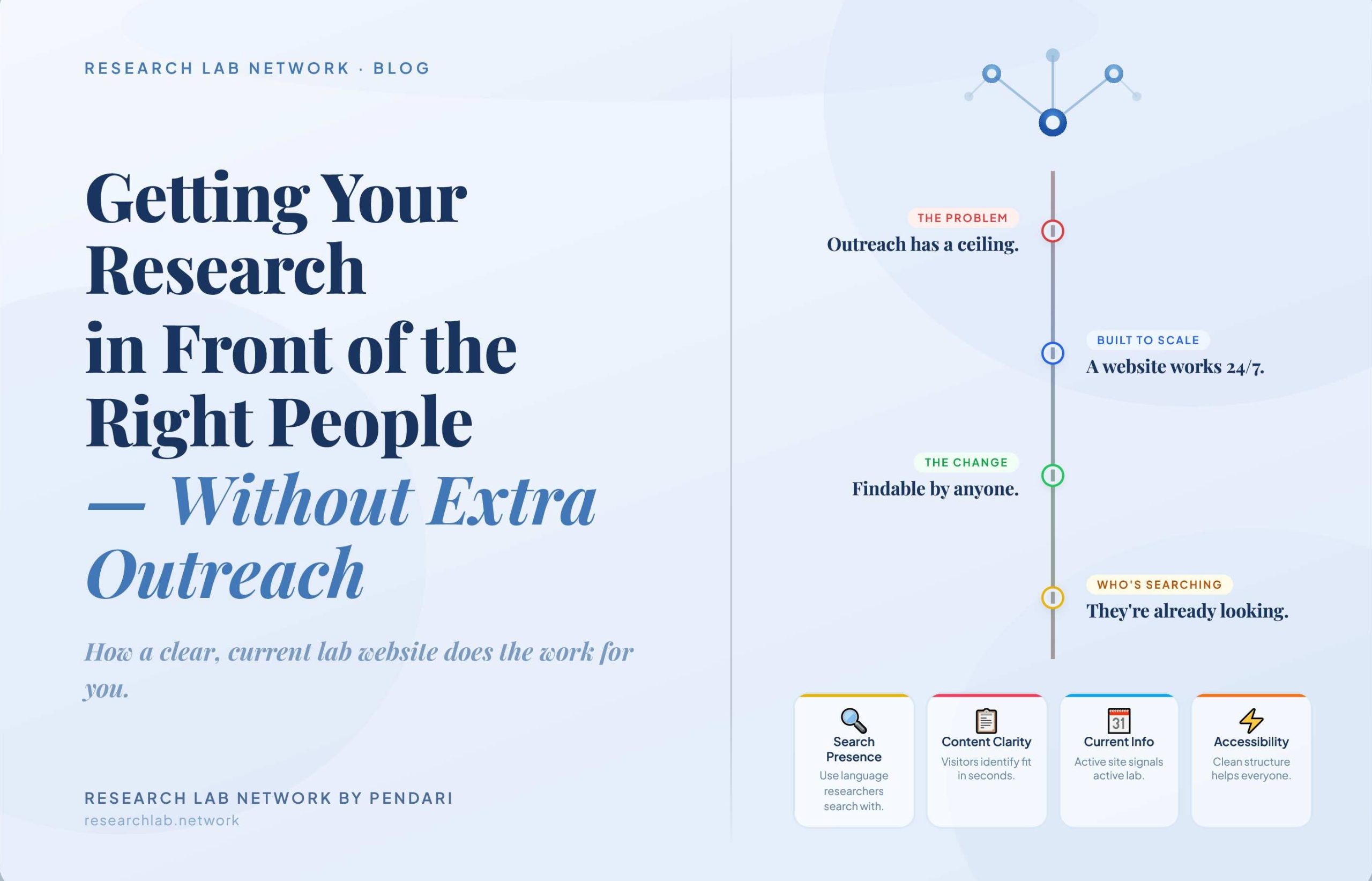
Getting Your Research in Front of the Right People — Without Extra Outreach

For most research labs, visibility is treated as a function of effort. More emails, more conference presentations, more networking. And while those things matter, they are not the only way, or even the most scalable way, to get your research in front of the people who need to see it.

The labs that consistently attract strong collaboration inquiries, talented recruits, and funding attention are not necessarily the ones doing the most outreach; they are often simply the easiest to find.

Why Outreach Alone Does Not Scale

Outreach is valuable, but it has a ceiling. A PI can only send so many emails, attend so many conferences, and maintain so many professional relationships at once. Beyond a certain point, adding more outreach does not meaningfully expand a lab's reach; it just adds to an already full workload.

However, a well-maintained digital presence scales reach. Unlike a cold email, a lab website works around the clock. It is findable by anyone, at any time, regardless of whether someone in the lab is actively reaching out. And unlike a conference presentation, it does not disappear after the event ends.

The shift from outreach-dependent visibility to organic visibility is not about doing less. It is about building something that works continuously in the background, so that the right people can find the lab.

The People Already Searching for What Your Lab Does

At any given time, researchers, graduate students, postdocs, collaborators, and funding agencies are actively searching for labs working in specific areas. Some through Google. Others are following citation trails, browsing university department pages, or looking at who is publishing in a particular journal.

In each of these cases, the question is the same: Does this lab work on what I need? And the answer, for most of the people searching, comes from whatever they find online, not from a direct introduction.

This means that visibility is not just about being known. It is about being findable to the right people at the moment they are looking. A lab with a clear, current, well-organized website is positioned to capture that attention naturally. A lab without one is effectively invisible to everyone except those who already know it exists.

What Makes a Lab Findable

Being easy to find is because several elements work together, and understanding each one makes it easier to close the gap between where a lab's visibility currently is and where it could be.

Search engine presence. When someone searches for a lab working in a specific area, search engines look for websites that clearly and consistently communicate what the lab does. This means having a research page that uses the same language researchers use when they search, updated publications that signal active work, and a site structure that search engines can read and index effectively.

Content clarity. Even when a lab's website ranks well in search results, a visitor still needs to quickly understand whether the lab's focus aligns with their needs. A research page that describes broad interests rather than active projects, or a publications list that is years out of date, creates friction at exactly the moment someone is deciding whether to reach out. Clarity removes that friction.

Current information. A website that reflects where the lab is today, not where it was two or three years ago, signals to visitors that the lab is active and worth contacting. Outdated content, by contrast, raises doubts even when the underlying research is strong. Keeping the site current is one of the highest-leverage things a lab can do for its visibility.

Accessibility and structure. A well-structured and accessible site is easier for both search engines and human visitors to navigate. Logical heading structure, clean navigation, and fast load times all contribute to a site performing better in search results and being easier to use once someone arrives.

Organic Visibility as a Long-Term Asset

One of the most important differences between outreach and organic visibility is how they compound over time. Outreach produces results in proportion to the effort put in; when the effort stops, so do the results. Organic visibility, on the other hand, builds on itself. A well-maintained website that clearly communicates a lab's research focus gets easier to find over time, not harder, as its search presence grows and more people discover and link to it.

This makes investing in digital presence one of the highest-return things a lab can do for its long-term visibility. The work done today: keeping the site current, organizing publications clearly, and structuring research pages around active projects, continues paying off for years without requiring ongoing effort in proportion to the results.

Where to Start

For labs that want to improve their organic visibility without adding to their workload, the most practical starting point is an honest assessment of what the current website communicates to a first-time visitor.
Does the research page reflect where the lab is today? Are recent publications easy to find? Is it clear, within the first few seconds of landing on the site, what the lab works on and who to contact?

If the answers to those questions are uncertain, that is where the work starts. Not with more outreach, but with making sure that the lab's existing work is as visible and legible as it deserves to be.

Purpose-built platforms like Research Lab Network are designed to make this easier by providing the structure, templates, and content tools that keep lab websites current and clearly organized without requiring significant time investment from the lab itself.


Research Lab Network helps academic research labs build and maintain websites that get their research in front of the right people, collaborators, students, and funding agencies, without extra outreach. 

A lab website is not a project with a finish line.

What Long-Term Lab Website Support Actually Looks Like in Practice

Most labs invest significant time in creating and launching their websites. What gets far less attention is lab website support: the ongoing work that keeps a site up-to-date, functional, and relevant long after launch day. For research labs, that gap between launch and long-term reality is where things turn south.

People join and leave. Publications accumulate. Projects evolve. Grants are awarded and concluded. A website that accurately represents a lab on launch day will misrepresent it within months if nobody is actively maintaining it.

Why Informal Lab Website Support Falls Short

For most labs, support for lab websites is informal at best. A graduate student who built the site handles updates when asked. A lab manager adds publications when they remember. The PI reviews the homepage once a year and notes that the team page is outdated.

This arrangement works until it doesn't. The graduate student defends and moves on. The lab manager changes roles. The PI is managing a grant renewal, and the website quietly falls behind.

The result is a site that looks like a snapshot of the lab from a year or two ago — which is exactly what collaborators, prospective students, and funding agencies see when they visit.

Informal lab website support is not really support. It is deferred maintenance.

What Consistent Lab Website Support Actually Requires

Keeping a lab website current and functional over time involves more than the occasional edit. Effective lab website support requires a consistent approach to four things:

  1. Content Updates
    • Publications need to be added regularly. Member profiles need to reflect who is still in the lab. Research pages need to stay aligned with the lab's current focus. News and announcements: grants, awards, and media coverage need to be posted while they are still relevant.
  2. Technical Maintenance
    • Plugins and platform components need to be updated to stay secure and functional. Broken links need to be identified and fixed. Forms and contact pages need to be tested periodically. Performance and load speed need to be monitored.
  3. Structural Consistency
    • As content grows, the site needs to remain organized and easy to navigate. A publications section that made sense with 20 papers needs to still make sense with 80. Member profiles added over the years need to follow a consistent format. Navigation needs to reflect the site's current scope.
  4. Continuity Through Transitions
    • Lab websites change hands frequently. When the person responsible for lab website support moves on, whoever takes over needs to understand and maintain the site without starting from scratch. This requires a clear structure and a platform that does not depend on specialized technical knowledge to operate.

The Transition Problem in Lab Website Support

Of all the challenges in long-term lab website support, transitions are the most disruptive and the least planned for.

Every lab eventually faces a moment where the person responsible for the website is no longer available, a graduation, a job change, or a shift in lab responsibilities. At that point, one of three things typically happens: someone else inherits the site and figures it out as they go, the site goes unmaintained until it becomes a problem, or the lab decides to rebuild from scratch.

None of these outcomes is good. The first leads to inconsistency, the second leads to the kind of outdated website that quietly undermines a lab's credibility, and the third is expensive and time-consuming, and it typically produces the same outcome a few years later.

The only sustainable alternative is a website built on infrastructure designed to survive transitions, with clear content structures, predictable layouts, and lab website support that does not depend on a single person inside the lab.

What Purpose-Built Lab Website Support Looks Like

Effective lab website support looks nothing like the informal arrangements most labs rely on. It is structured, consistent, and designed around the specific ways lab content changes over time.

With Research Lab Network, lab website support is built into how the platform works rather than treated as an add-on. Here is what that means in practice:

Structured Content Management

Publications, team members, research projects, and news are managed through dedicated systems rather than manually edited pages. Adding a new publication does not require touching the site's design or layout; it is entered into a structured format and displayed consistently. This makes lab website support faster, reduces errors, and keeps the site organized as it grows.

Ongoing Technical Maintenance Handled Externally

Technical updates, security patches, and platform maintenance are handled on the infrastructure side, not left to the lab. A PI or lab manager does not need to think about whether plugins are up to date or whether a recent update broke something on the publications page.

Consistent Structure Through Member Turnover

Because content follows defined templates rather than free-form pages, new people who take over the lab website support role inherit a system they can understand immediately. The structure is self-documenting; no tribal knowledge required.

Support From a Team That Understands Academic Content

Generic website support services do not know what a PI is, why a Natural History Study page matters, or how to present research in a way that makes sense to a funding agency. Lab website support from a team that works exclusively with research labs means updates are handled with the right academic context, not just technical execution.

Why Lab Website Support Matters More Than Most Labs Realize

A lab website that is actively maintained does more than look professional. It signals that the lab is organized, active, and serious about communicating its work.

That signal matters to prospective students evaluating whether to reach out. It matters to collaborators deciding which labs to contact. It matters to program officers forming impressions before a review. A site that is clearly current and well-maintained builds confidence before a single conversation takes place.

The inverse is equally true. An outdated website raises questions about a lab's momentum and organization, regardless of how strong the research is.

Long-term lab website support is not a nice-to-have. It is what separates a website that works for years from one that becomes a liability.


Research Lab Network provides purpose-built lab website support and infrastructure for academic research labs — so your website stays current, professional, and accurate without adding to your team's workload. Learn more here

The right collaborators are already searching for what your lab does.

How Clearly Communicating Your Research Focus Attracts the Right Collaborators

Most research collaborations don't start with a cold email. They start with someone reading about your work: a cited paper, a research abstract, or more often than researchers expect, your lab's website.

And when a potential collaborator lands on your website, they're usually moving fast. They have a specific problem in mind, they're evaluating a handful of labs at once, and they're trying to determine whether your work intersects with theirs quickly.

The labs that make that easy to figure out tend to get the inquiry. The ones that don't, may never even know the opportunity existed.

What Collaborators Are Looking For

When a researcher visits your lab's website, they're not conducting a deep review of your body of work. They're trying to answer one question quickly: Does this lab work on what I need?

That means your current projects, recent publications, and active research areas need to be easy to find and easy to understand at a glance. Not simplified, but organized in a way that makes alignment immediately recognizable to another expert in the field.

A well-structured research page with clearly named projects and a publications section that highlights recent work goes a long way toward answering that question before a visitor has to look for it themselves.

Current Work Should Be Easy to Find

One of the most common friction points for collaborators is landing on a lab website and not being able to locate the lab's current research quickly.

A research page that prominently features active projects, with clear titles and enough context to understand the focus, removes that friction. So does a publications section that makes recent work visible without requiring someone to scroll through an extensive archive to find it.

This isn't about restructuring how you present your science. It's about making sure the most relevant information is surfaced where visitors are most likely to look for it.

The Compounding Effect

When your website makes it easy to understand your lab's current focus, the collaboration inquiries you receive tend to be better aligned. Researchers who reach out have already identified that your work intersects with theirs. Conversations start from a more informed place and are more likely to lead somewhere productive.

Over time, this builds on itself. Labs with clear, current digital presences develop reputations for specific areas of expertise; they are easier to find and remember when someone needs a collaborator with exactly their focus.

What Funding Agencies Notice Too

It's not only collaborators who look up your website. Program officers and reviewers may visit a lab's site when evaluating a proposal, not to assess the science directly, but to get a sense of the lab's focus and recent activity.

A website that reflects an active, well-organized research program reinforces the credibility of a grant application. It signals that the lab is productive, current, and serious about communicating its work.

The Practical Takeaway

You don't need more outreach to attract better collaborators. You need your existing work to be easy to find and easy to understand for researchers who are already looking for what you do.

That comes down to a website that keeps current projects visible, surfaces recent publications, and makes it straightforward for an interested researcher to understand your lab's focus and get in touch.

Purpose-built platforms like Research Lab Network are designed around exactly these needs, so the structure is already in place, and keeping your site current doesn't require significant time or effort on top of everything else a lab is managing.

Research Lab Network helps academic research labs build and maintain websites that keep their work visible to the right collaborators and funding agencies.

5 Tips for Maintaining a Lab Website That Scales With Your Research

5 Tips for Maintaining a Lab Website That Scales With Your Research

Most lab websites start the same way: a graduate student builds something functional, the PI approves it, and everyone moves on. For a while, it works.

Then the lab grows. Publications pile up. Members join and leave. Projects branch in new directions. And the website, built for the lab it was, not the lab it became, starts to crack under the weight of its own growth.

Scaling a lab website is not about rebuilding it every few years. It is about building and maintaining it in a way that grows with your research from the start. Here are five practical tips for doing that.

1. Use Structured Content Instead of Free-Form Pages

The most common reason lab websites become unmanageable is that content was added without structure. Publications get pasted as plain text. Member bios live in a single wall of copy. Project descriptions are buried in PDFs that search engines cannot read.

Structured content means each type of information: publications, team members, projects, news, lives in its own defined format with consistent fields. A publication entry always has a title, authors, journal, year, and DOI. A team member profile always has a name, role, photo, and bio.

This matters for scaling because:

  • New content can be added without redesigning anything
  • Filtering, sorting, and searching become possible
  • Search engines can index your content more effectively
  • Anyone on the team can add content without breaking the layout

If your current website treats every page as a blank canvas, that flexibility will work against you as the site grows. Defined content types are what make a website maintainable at scale.

2. Choose a Template Designed for Research Content

Generic website builders and most university CMS platforms were not designed with lab content in mind. They handle blog posts and contact forms well. But they handle publication archives, PI profiles, and research project hierarchies poorly.

A template built specifically for research labs solves this by providing the right structures: a publications section organized by year, a team page that handles graduate students and postdocs gracefully, and a news feed for updates, grants, and awards.

The practical benefit is compounding. When your template already anticipates the content your lab produces, every new addition takes minutes instead of hours. You are not fighting the system; you are working with it.

This is why purpose-built platforms matter. A lab that starts on infrastructure designed for research content will spend a fraction of the time on maintenance compared to one working around a generic template.

3. Build ADA-Compliant Design In From the Start

Accessibility is not a feature you add later. It is a characteristic of how a site is built, and retrofitting it after the fact is one of the most expensive mistakes a lab can make.

Federally funded institutions are required to meet accessibility standards. The benchmark is WCAG 2.1 AA compliance, some of which covers:

  • Color contrast ratios on all text and visual elements
  • Alt text on every image
  • Keyboard navigability across all menus, forms, and interactive elements
  • Logical heading structure readable by screen readers

Beyond legal compliance, accessible design simply works better. High contrast text is easier to read for everyone. Clean navigation reduces bounce rates.

The cleanest path to compliance is choosing a platform or template that builds these standards, so every page created inherits them automatically. When accessibility is structural, it does not require ongoing manual effort to maintain.

4. Establish a Minimal But Consistent Update Rhythm

The number one reason lab websites go stale is the absence of any maintenance routine. There is no single person responsible, no schedule, and no defined scope, so nothing gets updated until the site becomes embarrassing enough to prompt a rebuild.

You do not need a dedicated webmaster. You need a minimal system.

A sustainable update rhythm for most labs can look something like this:

  • Monthly: Add new publications, update member profiles for anyone who has joined or left
  • Quarterly: Review the research and projects pages for accuracy, update the news feed with any awards, grants, or media coverage
  • Annually: Audit the full site for broken links, outdated content, and any accessibility issues introduced by new content

The key is assigning ownership. One lab member, often a senior graduate student or lab manager, should be responsible for each update category. When responsibility is diffuse, nothing gets done.

Platforms with streamlined content management make this significantly easier. If adding a publication takes two minutes rather than twenty, the update rhythm actually holds.

5. Treat Your Website as a Recruitment and Collaboration Tool

Labs that maintain their websites well tend to share one mindset: they think of the website as an active communication tool, not a static archive.

This reframe matters because it changes what you prioritize. A static archive needs to be accurate. An active communication tool needs to be accurate, current, and compelling — especially to the two audiences that matter most for lab growth: prospective researchers and potential collaborators.

For prospective students and postdocs, your website is often the deciding factor between emailing you and moving on. A publications page last updated two years ago signals a lab in decline, regardless of what the actual research looks like. A clear, current open positions page with a straightforward application process removes friction at exactly the moment a strong candidate is making a decision.

For collaborators, a well-organized research page that clearly articulates your lab's current focus areas makes it easy for other researchers to identify alignment and reach out. That visibility compounds over time.

The labs with the strongest digital presence are not necessarily the ones with the most resources. They are the ones who decided their website was worth maintaining.

Putting It Together

These five principles reinforce each other. Structured content makes templates work better. Accessible templates reduce compliance risk. A consistent update rhythm keeps structured content current. And treating your website as a communication tool gives your team the motivation to maintain it.

The labs that get this right are not the ones that invested the most in web development. They are the ones who started with the right infrastructure and built sustainable habits around it.

If your current website was not built with any of these principles in mind, the good news is that switching to purpose-built infrastructure, like Research Lab Network, is often faster and less disruptive than a full rebuild. The templates, structure, and compliance foundations are already there. You bring the research.

Research Lab Network provides purpose-built website infrastructure for academic research labs, designed to scale, stay compliant, and keep your lab's work visible.

What do funding agencies look for on a lab website?

What Funding Agencies Expect on a Lab Website

A lab website is often where a reviewer, collaborator, or funding agency representative looks to understand a research group’s work.

While proposals and CVs carry the formal weight of an application, the research lab website plays a supporting role in establishing credibility, transparency, and organization.

Funding agencies and reviewers are not looking for elaborate designs; they are looking for clarity, structure, and evidence of active research.

Clear Presentation of Research Focus

Reviewers want to quickly understand:

  • What the lab studies
  • The problems it addresses
  • Its current research directions

A lab website should present this information clearly and without unnecessary complexity.

If a reviewer cannot identify the lab’s research areas, the site creates friction rather than confidence.

Structured layouts that separate research areas into defined sections make this clarity possible.

Organized and Up-to-Date Publications

Publications are central to evaluating a lab’s impact and trajectory.

Funding agencies expect to see:

  • Recent publications clearly listed
  • Consistent citation formatting
  • Logical organization

Long, manually formatted lists can be difficult to scan and may signal a lack of maintenance.

Structured systems, such as dedicated publication fields managed through our Pendari plugins, ensure consistency and make it easier for reviewers to assess output.

An organized research lab website reinforces professionalism.

Transparent Lab Membership

Reviewers often assess the composition and strength of a research team.

A lab website should clearly identify:

  • Principal investigators
  • Current members
  • Alumni (when relevant)

Profiles should be current and easy to navigate.

When lab membership is outdated or difficult to interpret, it may raise questions about the lab’s activity level.

Structured templates that centralize member information help maintain accuracy over time.

Evidence of Ongoing Activity

Funding bodies look for signs that a lab is active and engaged.

This may include:

  • Recent publications
  • Active projects
  • News or updates
  • Collaborations

A well-structured academic lab website makes these indicators visible without requiring visitors to scan the site extensively.

When content is managed systematically, updates are more likely to remain consistent.

Professionalism and Accessibility

Reviewers do not expect complex designs. They expect usability.

A research lab website should:

  • Load quickly
  • Be easy to navigate
  • Follow accessibility best practices

Increasingly, accessibility and WCAG alignment are viewed as part of institutional responsibility. An inaccessible site can undermine otherwise strong research credentials.

Our templates at Research Lab Network are designed with accessibility in mind to reduce this risk.

Why Structure Matters

The common thread across these expectations is structure.

Funding agencies and reviewers are evaluating clarity, organization, and evidence of impact. A lab website that relies on manual formatting can quickly become inconsistent.

Purpose-built academic website templates combined with structured content systems, such as Pendari plugins for publications, people, and research, help maintain organization as the lab grows.

Content is entered once, displayed consistently, and updated efficiently.

This allows the website to reflect the lab’s work accurately over time.

Conclusion

A lab website is not simply a digital brochure; it is part of how funding agencies and reviewers evaluate credibility and research activity.

Clear research descriptions, organized publications, transparent team information, and accessible design all contribute to a professional presentation.

Labs that approach their website strategically, using structured templates and content systems, are better positioned to present their work with clarity and confidence.

Why Accessibility Is Non-Negotiable for Academic Websites

Why Accessibility Is Non-Negotiable for Academic Websites

Academic website accessibility is no longer a secondary consideration. Across universities, accessibility expectations are tightening due to regulatory requirements, institutional policies, and increased scrutiny tied to public funding.

For research labs, this shift has practical implications. A research lab website is not independent from its university; it is part of the institution’s digital footprint. That means accessibility standards apply just as strongly to lab websites as they do to central university pages.

Understanding why accessibility is becoming non-negotiable helps labs prepare proactively rather than reactively.

Regulatory Pressure Is Increasing

In the United States, digital accessibility obligations for universities are grounded in the Americans with Disabilities Act (ADA) and Section 504 of the Rehabilitation Act. Public universities, as recipients of federal funding and public entities, are required to ensure that their digital content is accessible. While Section 508 formally applies to federal agencies, many universities align with its technical standards, which reference WCAG guidelines.

While enforcement has varied, legal complaints related to inaccessible university websites have increased. Institutions are responding by strengthening internal compliance requirements.

As a result, university website accessibility standards now frequently extend to department and lab websites.

Accessibility is no longer just best practice; it is risk management.

Funding Expectations Are Evolving

Research labs get grants from federal agencies, foundations, and institutional programs. These funding bodies increasingly emphasize inclusion, equity, and public access.

An inaccessible research lab website can conflict with these expectations.

When research is publicly funded, there is an implicit expectation that the resulting information is publicly accessible. This includes individuals using screen readers, keyboard navigation, or other assistive technologies.

Website accessibility compliance supports broader institutional commitments to equity and inclusion.

Universities Are Formalizing Accessibility Policies

Many universities now conduct periodic accessibility scans of affiliated websites. Labs may receive notices requiring remediation if their site fails automated or manual checks.

Some common issues are:

  • Missing alt text for images
  • Improper heading structure
  • Low color contrast

Because lab websites are often built independently, they may not automatically meet university web accessibility standards.

Remediation can be complex and costly if accessibility was not considered from the start.

Accessibility Impacts More Than Compliance

Beyond regulatory and institutional concerns, accessibility affects usability more broadly.

Clear heading structure improves readability.
Proper contrast improves visibility.
Logical navigation improves user experience.

Accessibility best practices often lead to a better overall design and clearer communication.

For research labs, this impacts recruitment, collaboration, and public engagement.

Building With Accessibility in Mind

For new lab websites, incorporating accessibility from the beginning is far more efficient than retrofitting later.

An ADA-compliant academic website considers:

  • WCAG guidelines during design
  • Accessible navigation structures
  • Compatibility with assistive technologies

This approach reduces long-term maintenance costs and aligns with institutional standards.

Conclusion

Academic website accessibility is becoming non-negotiable due to regulatory frameworks, funding expectations, and formal university policies. Research labs are increasingly expected to meet the same digital standards as their institutions.

Understanding these pressures allows labs to approach accessibility strategically rather than reactively, ensuring that a research lab website meets accessibility standards supports compliance, inclusion, and long-term sustainability.

Publications page in a generic builder vs. Research Lab Network

Why Generic Website Builders Fall Short for Research Labs

Research Lab Website: Why Generic Builders Fall Short Many research labs use generic website builders because they are easy to access and quick to launch. However, these platforms were not designed for academic content. As publications accumulate, projects evolve, and lab membership changes, maintaining a clear and organized research lab website becomes increasingly difficult. We […]

Introducing Research Lab Network

Introducing Research Lab Network: A Platform Built for Academic Lab Websites

An academic lab website is often the primary place where its work is presented to the world. It showcases lab members, research projects, and publications, and helps establish credibility with collaborators, funding agencies, and prospective students.

Yet most lab websites are built using generic tools that were never designed for research environments. As a result, many labs struggle with disorganized publication lists, outdated member pages, and an academic lab website that is difficult to maintain.

Research Lab Network was created to provide a better foundation.

Designed Around the Structure of Research Labs and Built to Support Long-Term Growth

Research labs manage information differently from most organizations. Publications accumulate over time, students graduate, and research directions evolve.

Research Lab Network provides built-in systems to manage:

  • Lab members and alumni

  • Publications

  • Research areas and projects

It was designed to accommodate these changes without requiring frequent redesigns. This structure keeps information organized and makes updates straightforward, without relying on manual formatting, as the lab grows.

This allows labs to maintain a professional online presence without ongoing technical overhead.

Launch Quickly Using Purpose-Built Templates

Starting a website from scratch can be slow and technically demanding. Research Lab Network offers professionally designed templates created specifically for academic use.

Labs can select a design, add their content, and launch a fully functional website in a fraction of the time. Each template is designed to present research clearly and consistently, while remaining easy to maintain.

Accessibility and Institutional Expectations

Universities increasingly expect lab websites to meet accessibility standards. Research Lab Network templates are developed with accessibility best practices in mind, helping labs align with institutional requirements and avoid costly remediation later.

A Better Foundation for Presenting Research

A well-designed lab website supports recruitment, collaboration, and visibility. More importantly, it allows labs to present their work clearly and accurately.

Research Lab Network provides a platform designed specifically for that purpose. Combining academic-focused templates with structured content management, it gives research labs a reliable and sustainable way to build and maintain their websites.

Ready to launch a better lab website? Explore Research Lab Network by Pendari and see how quickly your lab can get online.