For most research labs, visibility is treated as a function of effort. More emails, more conference presentations, more networking. And while those things matter, they are not the only way, or even the most scalable way, to get your research in front of the people who need to see it.
The labs that consistently attract strong collaboration inquiries, talented recruits, and funding attention are not necessarily the ones doing the most outreach; they are often simply the easiest to find.
Why Outreach Alone Does Not Scale
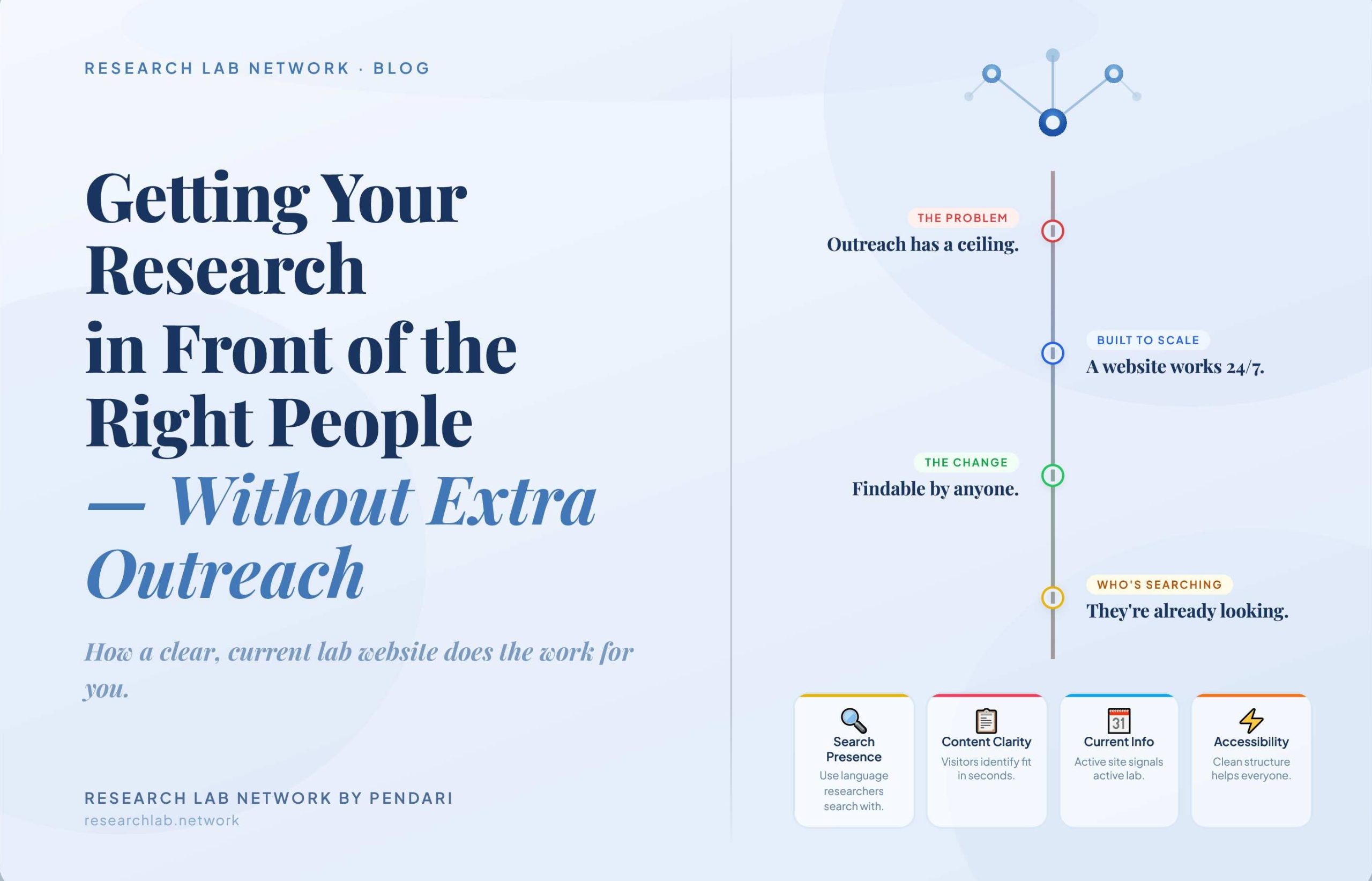
Outreach is valuable, but it has a ceiling. A PI can only send so many emails, attend so many conferences, and maintain so many professional relationships at once. Beyond a certain point, adding more outreach does not meaningfully expand a lab’s reach; it just adds to an already full workload.
However, a well-maintained digital presence scales reach. Unlike a cold email, a lab website works around the clock. It is findable by anyone, at any time, regardless of whether someone in the lab is actively reaching out. And unlike a conference presentation, it does not disappear after the event ends.
The shift from outreach-dependent visibility to organic visibility is not about doing less. It is about building something that works continuously in the background, so that the right people can find the lab.
The People Already Searching for What Your Lab Does
At any given time, researchers, graduate students, postdocs, collaborators, and funding agencies are actively searching for labs working in specific areas. Some through Google. Others are following citation trails, browsing university department pages, or looking at who is publishing in a particular journal.
In each of these cases, the question is the same: Does this lab work on what I need? And the answer, for most of the people searching, comes from whatever they find online, not from a direct introduction.
This means that visibility is not just about being known. It is about being findable to the right people at the moment they are looking. A lab with a clear, current, well-organized website is positioned to capture that attention naturally. A lab without one is effectively invisible to everyone except those who already know it exists.
What Makes a Lab Findable
Being easy to find is because several elements work together, and understanding each one makes it easier to close the gap between where a lab’s visibility currently is and where it could be.
Search engine presence. When someone searches for a lab working in a specific area, search engines look for websites that clearly and consistently communicate what the lab does. This means having a research page that uses the same language researchers use when they search, updated publications that signal active work, and a site structure that search engines can read and index effectively.
Content clarity. Even when a lab’s website ranks well in search results, a visitor still needs to quickly understand whether the lab’s focus aligns with their needs. A research page that describes broad interests rather than active projects, or a publications list that is years out of date, creates friction at exactly the moment someone is deciding whether to reach out. Clarity removes that friction.
Current information. A website that reflects where the lab is today, not where it was two or three years ago, signals to visitors that the lab is active and worth contacting. Outdated content, by contrast, raises doubts even when the underlying research is strong. Keeping the site current is one of the highest-leverage things a lab can do for its visibility.
Accessibility and structure. A well-structured and accessible site is easier for both search engines and human visitors to navigate. Logical heading structure, clean navigation, and fast load times all contribute to a site performing better in search results and being easier to use once someone arrives.
Organic Visibility as a Long-Term Asset
One of the most important differences between outreach and organic visibility is how they compound over time. Outreach produces results in proportion to the effort put in; when the effort stops, so do the results. Organic visibility, on the other hand, builds on itself. A well-maintained website that clearly communicates a lab’s research focus gets easier to find over time, not harder, as its search presence grows and more people discover and link to it.
This makes investing in digital presence one of the highest-return things a lab can do for its long-term visibility. The work done today: keeping the site current, organizing publications clearly, and structuring research pages around active projects, continues paying off for years without requiring ongoing effort in proportion to the results.
Where to Start
For labs that want to improve their organic visibility without adding to their workload, the most practical starting point is an honest assessment of what the current website communicates to a first-time visitor.
Does the research page reflect where the lab is today? Are recent publications easy to find? Is it clear, within the first few seconds of landing on the site, what the lab works on and who to contact?
If the answers to those questions are uncertain, that is where the work starts. Not with more outreach, but with making sure that the lab’s existing work is as visible and legible as it deserves to be.
Purpose-built platforms like Research Lab Network are designed to make this easier by providing the structure, templates, and content tools that keep lab websites current and clearly organized without requiring significant time investment from the lab itself.
Research Lab Network helps academic research labs build and maintain websites that get their research in front of the right people, collaborators, students, and funding agencies, without extra outreach.